How Is International Shipping Charged?
International Express Measurement Video: Why are the dimensions measured by shippers often different from those measured by freight forwarders?
For international express shipments, the chargeable weight is the greater of the actual weight and the volumetric weight;
Actual weight refers to the weight of the parcel. The calculated weight is rounded up to the next half kilogram.
Volumetric weight is determined by the shipment’s density, or its actual weight per unit of volume.
Chargeable weight is the weight used to calculate the rate. It may be greater than the parcel’s actual weight or volumetric weight,
Volumetric weight formula: length × width × height / 5000. For example, a shipment measuring 30 × 30 × 40 has a volumetric weight of 30 × 30 × 40 / 5000 = 7.2KG (dimensions are measured in cm. Any fraction of a centimeter is rounded up to the next whole centimeter; for example, 16.4cm is counted as 17cm);
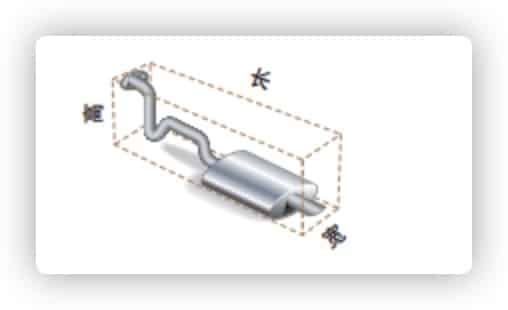
PS: Note that international express dimensions are measured differently from domestic shipments. Irregularly shaped parcels are treated as regular rectangular boxes. Measure the parcel’s length, width, and height from its outermost points. See the image below.
Shipping costs are then calculated based on the destination country and chargeable weight.
Multiple parcels in one shipment:
For each parcel, take the greater of the actual and volumetric weights and round it up to a whole number. Then add the chargeable weight of each parcel to get the total chargeable weight. For example:

The first box has a volumetric weight greater than its actual weight, at 19.8KG, so its chargeable weight is 20KG. The second box has an actual weight greater than its volumetric weight, at 26KG, so its chargeable weight is 26KG. The same applies to the remaining boxes. The total chargeable weight is 20 + 26 + 16 + 22 = 84KG;