Riding the Waves of Maritime Fuzhou: A Fishing Village Transforms into an International Silk Road Maritime Port in 20 Years
Looking ahead, the Jiangyin Port Area of Fuzhou will uphold its historic mission of “pioneering and innovating,” take serving the joint development of the Belt and Road Initiative as its starting point and breakthrough, build a global hub for resource allocation, and strengthen more core port industry clusters.
In the 1990s, while working in Fuzhou, General Secretary Xi Jinping personally led the preparation of the Strategic Vision for Fuzhou’s Economic and Social Development over 20 Years (known as the “3820” Strategic Project). It laid out an inspiring vision for Fuzhou and established its guiding principles and overall strategy.
The “Maritime Fuzhou” strategy was an important component of the “3820” Strategic Project. In June 1994, the Fuzhou Municipal Committee and Municipal Government issued the Opinions on Building “Maritime Fuzhou”, making Fuzhou one of the first coastal cities in China to declare its commitment to “advance toward the sea.”
With a blueprint to guide the way, in December 2002 the Jiangyin Port Area, Fuzhou’s first large container seaport, officially opened, ushering in a new chapter in the all-around pursuit of high-quality development and progress.
Every step of exploration and practice reflects the remarkable spirit of the times.
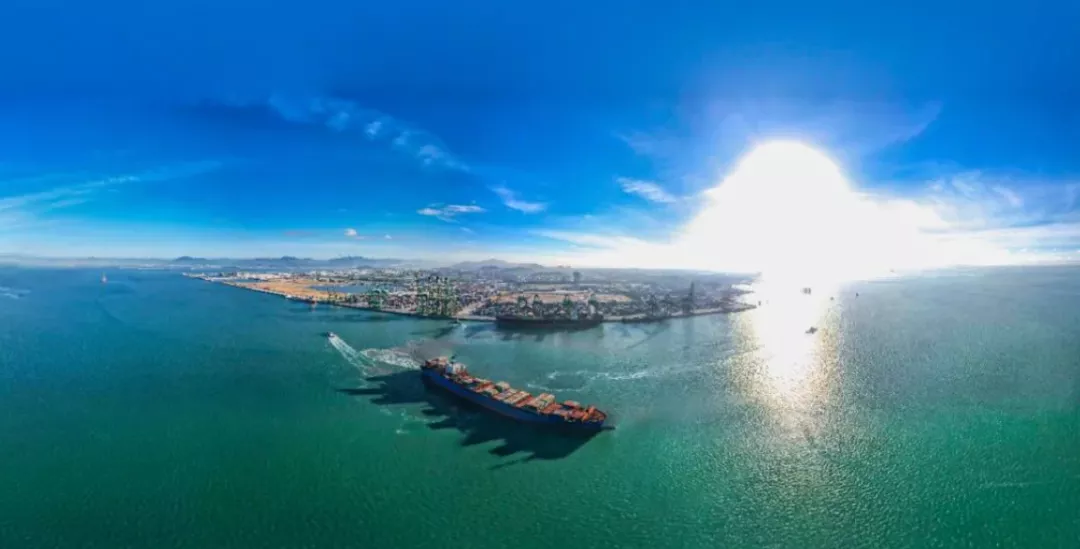
Over 20 years of sustained effort, the Jiangyin Port Area has kept General Secretary Xi’s instructions firmly in mind and vigorously upheld the spirit of “daring to lead and striving for success.” Through hard work and perseverance, it has transformed a fishing village on a peninsula into an international port connected to the world.
Over 20 years of advancing along the Silk Road, the Jiangyin Port Area has made effective use of the overlapping policies of the Special Economic Zone, the Pilot Free Trade Zone, the 21st Century Maritime Silk Road Core Area and other zones. Focused on serving and integrating into the new development paradigm, it has pursued deeper reform and higher-standard opening-up. It has handled a cumulative container throughput of 20 million TEUs and operates more than 60 domestic and international routes to near and distant ports, including 13 “Silk Road Maritime” routes, creating an upgraded shipping hub.
Over 20 years of transformation, Fuzhou Port has pursued leapfrog development with the goal of becoming a world-class deepwater port. It has advanced the integration of ports and logistics along the southeast coast, coordinated “water-road-rail” logistics resources, and leveraged the advantages of multimodal transport to achieve end-to-end coverage, connecting logistics corridors to rivers and seas and onward to the open ocean.
Time has etched the marks of hard work into history, while the journey toward our dreams shines with unwavering purpose. Over 20 years of striving toward their dreams, generations of Fuzhou Port workers have illuminated the road ahead with the light of faith, tempered their determination through hard work, and filled the sails of their dreams with the winds of confidence. They have kept the fate of the port’s development and progress firmly in their own hands.
“With development at heart, truth in our hands, and our feet on the right path, we are full of confidence and strength.” A Jiangyin Port Area official said that over the past 20 years, with strong support from governments at all levels, the parent group and relevant departments, Fuzhou Port Container Terminal has upheld the essence of the “3820” Project, kept in step with the times and aligned with national strategies, contributing “Jiangyin strength” to the development of Fuzhou and Fujian.
Looking ahead, the Jiangyin Port Area will forge ahead with determination, carry on and promote the “Maritime Fuzhou” strategy, set sail and brave the deep blue, making new contributions to the development of Fuzhou into a modern international city and to the building of a new Fujian.
Braving the Waves, Unleashing the Power of Perseverance
“Today, we stand at the starting point of creating the future, and should therefore embrace a forward-looking vision and dare to ride the tide of our times.” These words appear in the opening preface of the Strategic Vision for Fuzhou’s Economic and Social Development over 20 Years, drafted in November 1992.

In 1983, the first container ship sailed slowly out of Fuzhou Port, ushering in the port’s container shipping industry. In 1984, the State Council designated Fuzhou as one of China’s first 14 coastal port cities to open up to the outside world. From then on, Fuzhou was at the forefront of China’s opening-up, laying the foundation for Fuzhou Port’s international ambitions today.
The tides of the Min River surged, gathering momentum like a rainbow. In the 1990s, Xi Jinping, then Secretary of the Fuzhou Municipal Committee, personally led the implementation of the “3820” Strategic Project and proposed strategic initiatives such as “Maritime Fuzhou,” exerting a major and far-reaching influence on the development of Fuzhou Port at the turn of the century.
It was a passionate era of ambition, and from then on Fuzhou Port entered a fast track of development. That moment has since been etched into the hearts of Fuzhou Port workers as the spiritual starting point and compass for their efforts.
In 1998, Fuzhou Port adopted an even more open approach, bringing in the PSA International Group for the first time to jointly develop a specialized container terminal, pioneering major port projects built through Sino-foreign joint ventures in Fujian Province.
The Qingzhou Port Area was the starting point for container development at Fuzhou Port. By 2007, its container throughput had reached nearly 800,000 TEUs in its peak year.
In 2000, amid widespread anticipation and the thunderous boom of blasting, construction began on Berth 1 in the Jiangyin Port Area, sounding the call for a new round of development of “Maritime Fuzhou” at Fuzhou Port. With unwavering commitment, Fuzhou Port aligned itself with national strategies and advanced the development of Jiangyin into a major deepwater port.

In December 2002, Jiangyin Port officially opened. As the first large container seaport in Fuzhou’s history, it marked a new milestone in the development of Fuzhou Port.
Raising the Sails to Harness the Power of Progress
With the sea ahead and songs to spur us on, Fuzhou Port’s people have forged ahead through exploration, continuing to write brilliant chapters in the development of Fuzhou Port.
-
In 2003, Fuzhou Port opened its first ocean-going container route at the Jiangyin Port Area;
-
In 2004, the Jiangyin Port Area became a Class I port open to foreign trade;
-
In 2006, Fuzhou Port’s one-millionth container was lifted at Berth 2 in the Jiangyin Port Area; container throughput at Fuzhou Port surpassed the one-million-TEU mark for the first time;

-
In 2013, the integration and unified operation of Fuzhou Port’s container terminals not only strengthened the port’s container business, but also laid a solid foundation for the coordinated development of the Jiangyin Port Area’s container terminals and the establishment of an international shipping hub. The Jiangyin Port Area has worked to play a greater role in the development of a world-class port;
-
In 2014, the Jiangyin Port Area’s sea-rail intermodal transport project officially opened. Seamless connections between sea and rail created vast opportunities for the high-quality development of Fuzhou Port’s logistics industry, ushering in a period of rapid growth in diversified business;
-
In 2019, annual container throughput at the Jiangyin Port Area surpassed 2 million TEUs for the first time.

After 20 years of development, the Jiangyin Port Area has grown ever stronger.
The port area has handled a cumulative total of 20 million TEUs and over 10 million tonnes of bulk and general cargo. It has actively integrated into the Belt and Road Initiative, making full use of the advantages of its multiple overlapping zones. It now operates more than 60 domestic and international routes serving near and distant destinations, including 13 “Silk Road Maritime” routes, covering major ports around the world and connecting to major ports across China.
The international sea-rail intermodal transport corridor on the new land-sea trade route has achieved a major leap forward.
Sea-rail intermodal routes now connect the Jiangyin Port Area with central and western China, Southeast Asia and Europe, seamlessly linking the Maritime Silk Road with the Silk Road Economic Belt. The port has become a major international shipping hub on China’s southeast coast, radiating in both directions by sea and land across the Belt and Road. An integrated “port-shipping-land” service system has taken shape, with the port at its core and logistics as the link. Port-related logistics parks now coordinate multiple business segments, including sea-rail intermodal transport, vehicle logistics, bulk and general cargo, cold-chain logistics, cross-border e-commerce and oversized cargo logistics, further expanding the port’s economic hinterland.
Infrastructure construction has advanced by leaps and bounds.
With an annual design throughput capacity of 5 million TEUs, eight deep-water berths and a total quay length of 2,623 meters, it is the largest contiguous container port area under unified operation in Fujian Province. Its ability to accommodate 200,000-tonne ultra-large container ships around the clock, 365 days a year, gives the Jiangyin Port Area the strength to become a major international port.

Port and city grow together, advancing with steady strides.
As one of the core ports of the 21st-Century Maritime Silk Road and the largest contiguous container port area under unified operation in Fujian Province, the Jiangyin Port Area is building on the “Silk Road Maritime” initiative and leveraging the combined advantages of its location. By partnering with major global shipping companies, it is becoming a key gateway for the city’s international exchanges and a foundation for the development of key industries and development zones.
With leading companies such as Wanhua Chemical, Zhongjing Petrochemical and Tianchen Yaolong at its center, an industrial park specializing in new chemical materials has taken shape behind the Jiangyin Port Area, integrating upstream and downstream industries and optimizing resource allocation. A “1+2” industrial cluster led by new chemical materials and complemented by biomedicine and clean-energy equipment manufacturing is rapidly emerging, creating a distinctive “port + industry” advantage.
With industry and the city growing together, the Jiangyin Port Area continues to build momentum, bringing blue energy to urban development and writing new chapters in the Maritime Silk Road story.
Chasing the Light and Riding the Waves with an Ambitious Spirit
Today, as it embarks on a new journey, the Jiangyin Port Area has once again raised the banner of reform and innovation, with growing momentum for development.

The Jiangyin Port Area is now moving faster toward its goal of becoming a green, smart port that supports sustainable development. It is piloting applications for fully automated terminals and promoting the redesign of intelligent terminal operations and the adoption of energy-saving and emissions-reduction technologies.
From large to strong, and from rapid growth to high-quality development, Fuzhou Port’s people have drawn up an ambitious blueprint for a second takeoff and sounded a powerful call to carry reform and innovation through to the end.
With clear goals and decisive action, the port aims to become a world-class port with world-class facilities, technology, management and services. It will serve as a vital gateway and hub for Fujian Province’s opening up and cross-strait exchanges, providing strong support for building “Maritime Fujian” and promoting high-quality development of the marine economy.
The simplest principles are often the most profound; what matters most is getting the work done.
Looking ahead, the Jiangyin Port Area will uphold its historic mission to “pilot new approaches and test new policies,” using its role in supporting the Belt and Road Initiative as a starting point and breakthrough. It will become a hub for global resource allocation and build more robust port industry clusters.
Fuzhou Port, shining with the brilliance of maritime expansion, will also ride the waves of the 21st Century Maritime Silk Road and sail toward the future!